

If your website is not widely accessible to people with disabilities, you could face potential legal action under the Americans with Disabilities Act (ADA). Thousands of website owners across the USA receive accessibility-related lawsuits or demand letters. Therefore, understanding ADA compliance and implementing the right techniques in your websites is no longer a personal choice.

What is ADA compliance for websites?
The Americans with Disabilities Act (ADA) was signed into law in 1990 to prohibit discrimination against individuals with disabilities in all areas of public life. While the original law came before the advent of the modern internet, courts across the U.S. have consistently ruled that websites qualify as “places of public accommodation” under Title III of the ADA — meaning they must be accessible to everyone, including people with visual, auditory, motor, and cognitive disabilities.
ADA compliance for websites ensures your site is accessible to people who rely on screen readers, keyboard navigation, captions, and other assistive technologies. Furthermore, failure to meet the standards could expose your business to costly lawsuits, reputational damage, and federal enforcement action.
If you are unsure about the current status of your website, use an ADA website checker to spot and fix accessibility issues before they escalate into legal problems.
Understanding WCAG: The Technical Standard for ADA Compliance
While the ADA Act sets out the legal obligations, it does not exactly specify the technical requirements for websites. Here is where the WCAG (Web Content Accessibility Guide) comes in. Developed by the World Wide Web Consortium, it is based on 4 core principles:
- Perceivable — Information and UI components must be presentable to all users, including those using screen readers or requiring captions.
- Operable — All functionality must be accessible via keyboard, not just a mouse.
- Understandable — Content and navigation must be clear and consistent.
- Robust — Content must be compatible with current and future assistive technologies.
WCAG is structured into three levels of conformance:
- WCAG Level A — The minimum level of accessibility.
- WCAG Level AA — The widely accepted standard for legal compliance, referenced by courts, governments, and regulators worldwide.
- WCAG Level AAA — The highest level of conformance, typically required only for specialized accessibility-focused content.
For most businesses, achieving WCAG 2.1 Level AA compliance is the benchmark for ADA website compliance. The U.S. Department of Justice has formally recognized WCAG 2.1 AA as the appropriate standard for public-facing websites.
Getting there starts with a proper site-wide audit. WCAGSafe provides comprehensive accessibility auditing and remediation services to help your website meet WCAG 2.1 AA standards — and stay protected from ADA lawsuits.
Global Accessibility Laws: It’s Not Just the ADA
While ADA compliance is the primary concern for U.S.-based businesses, web accessibility is increasingly becoming a global legal requirement. If your website serves customers outside the United States, you may also need to comply with these key international standards:
European Accessibility Act (EAA)
The European Accessibility Act (EAA) came into full effect in June 2025, requiring businesses that sell products or services in the European Union to meet strict digital accessibility requirements. The EAA applies to e-commerce platforms, banking apps, transportation services, and more. Like the ADA, it references WCAG as its technical benchmark.
For businesses with any EU customer base, aligning with WCAG 2.1 AA addresses both ADA compliance and EAA obligations simultaneously.
Accessibility for Ontarians with Disabilities Act (AODA)
Canadian businesses operating in Ontario are subject to the Accessibility for Ontarians with Disabilities Act (AODA). Under AODA’s Integrated Accessibility Standards Regulation, organizations must meet WCAG 2.0 Level AA for all public-facing websites and web content. Non-compliance can result in significant fines from the Ontario government.
If your website serves Canadian visitors — particularly those in Ontario — AODA compliance is a legal requirement, not just a best practice.
Common ADA Website Compliance Issues
Most ADA accessibility lawsuits stem from the same recurring issues. Here we have listed the most common violations that put businesses at legal risk:
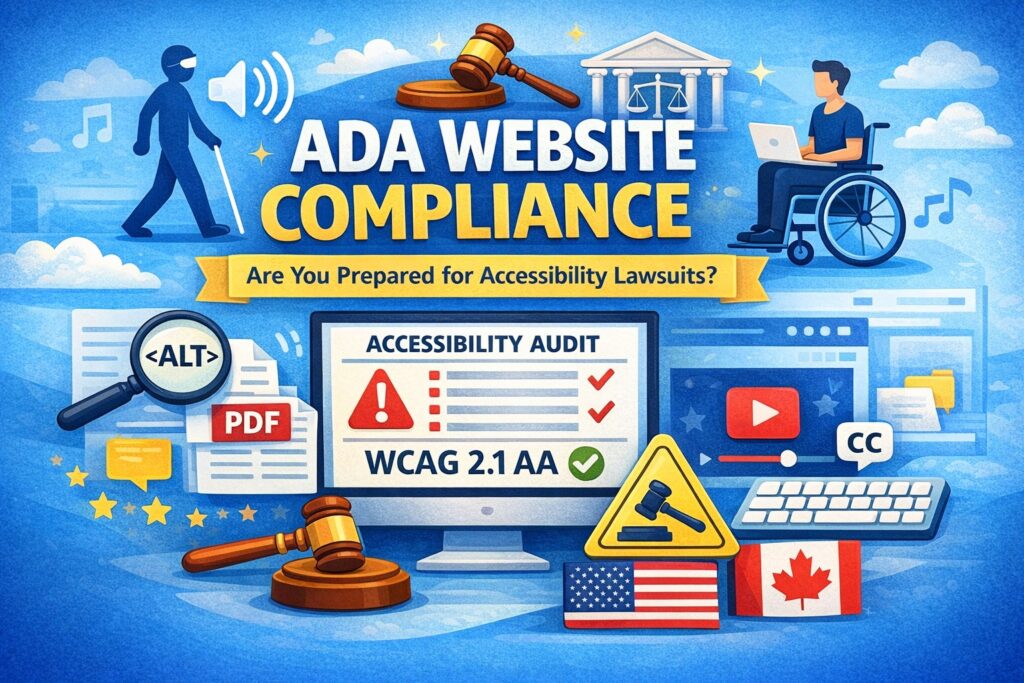
1. Missing Image Alt Text: Screen readers can’t interpret images without descriptive alt text. Every meaningful image on your website needs a clear, concise alt attribute.
2. Poor Color Contrast: Text that doesn’t have sufficient contrast against its background is difficult or impossible to read for users with low vision or color blindness. WCAG requires a minimum contrast ratio of 4.5:1 for normal text.
3. No Keyboard Navigation: Users with motor disabilities often navigate websites using only a keyboard. If your menus, forms, and interactive elements can’t be accessed without a mouse, your site is not ADA compliant.
4. Missing Form Labels: Every form field must have a properly associated label that screen readers can announce. Placeholder text is not a substitute for a label.
5. Videos Without Captions: Any video content on your website must include accurate closed captions for users who are deaf or hard of hearing.
6. Inaccessible PDFs: PDFs linked from your website must also be accessible — including proper tagging, reading order, and alt text for images within the document.
7. Auto-Playing Media: Media that plays automatically can be disorienting and inaccessible, particularly for users with cognitive disabilities or those using screen readers.
Identifying these issues before a plaintiff does is critical. An accessibility audit from WCAGSafe can surface these vulnerabilities and provide a clear remediation roadmap.
Final Thoughts: Don’t Wait for a Lawsuit to Take Action
The question for most businesses is no longer whether they need to address ADA website compliance — it’s whether they’ll act before or after receiving a demand letter. With web accessibility lawsuits at record highs and regulatory enforcement accelerating under both the ADA and international frameworks like the EAA and AODA, the cost of inaction far outweighs the cost of getting your wesbite to be compliant to these frameworks.
Thus, you should make accessibility a core part of how you build and maintain your website. Your users with disabilities deserve equal access — and your business deserves the legal protection that comes with providing it.
Start with a free consultation at WCAGSafe and take the first step toward a fully accessible, legally protected website today.